
How to Invest Money to Make Money: The Complete Beginner’s Guide (2026)
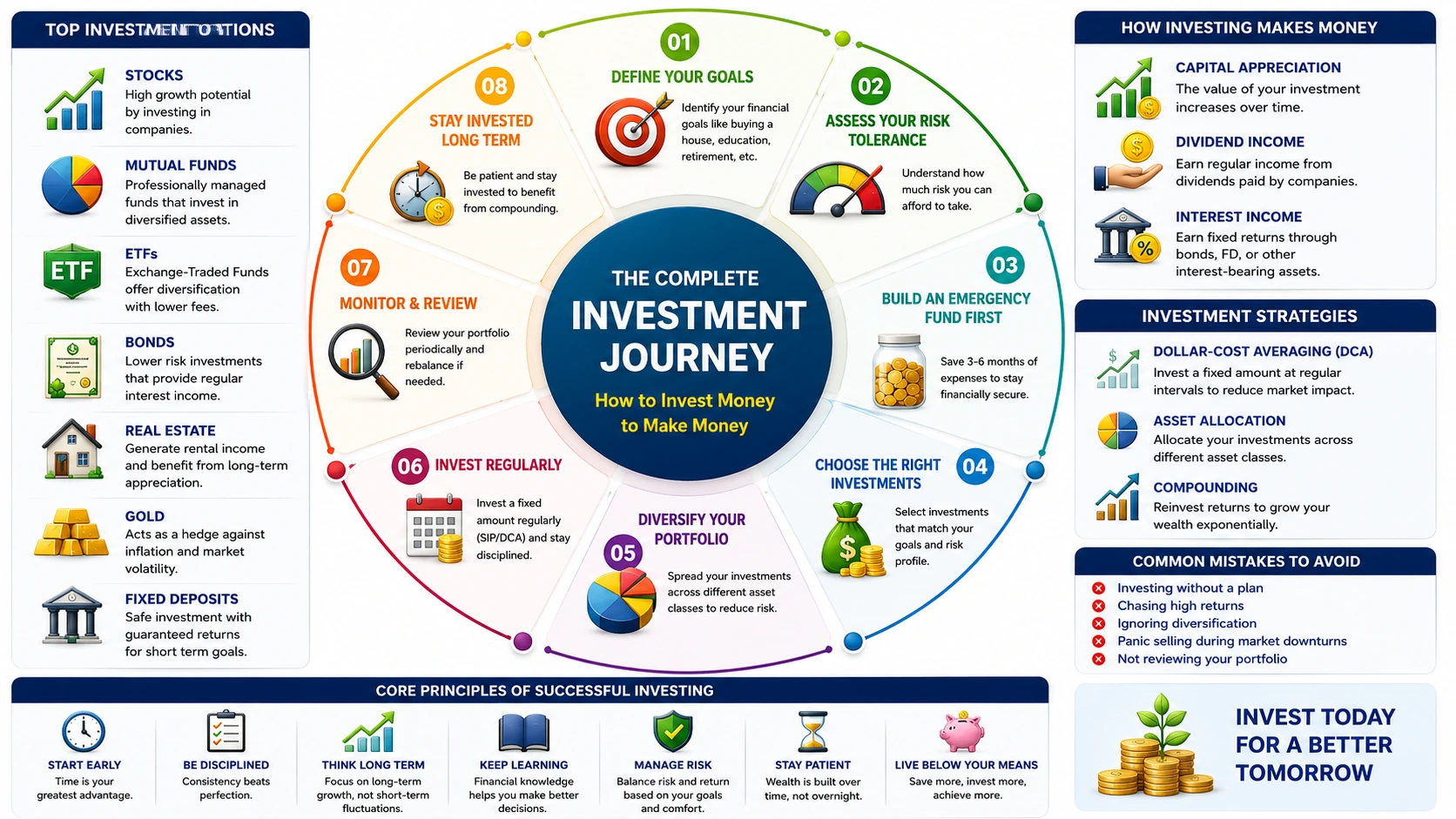
If you’ve ever wondered how some people grow their wealth while others struggle to keep up with rising prices, the answer often comes down to one simple habit—investing.
Money sitting in a savings account may feel safe, but over time inflation slowly reduces its purchasing power. Investing gives your money the opportunity to grow by earning returns over months and years instead of remaining idle.
The good news?
You don’t need to be rich to start investing.
You don’t need thousands of dollars.
And you certainly don’t need to be a financial expert.
Whether you’re a student, a salaried employee, a freelancer, or someone planning for retirement, learning how to invest money wisely can completely change your financial future.
In this guide, you’ll learn:
- What investing really means
- Why investing matters
- Different investment options
- How beginners should start
- Common mistakes to avoid
- Strategies that successful investors use
- How to build wealth safely over time
Let’s begin.
Table of Contents
- What Does Investing Mean?
- Why Should You Invest Your Money?
- How Does Investing Make Money?
- Types of Investments
- Best Investment Options for Beginners
- How Much Money Do You Need to Start?
- Step-by-Step Guide to Investing
- Investment Strategies That Actually Work
- Common Mistakes Beginners Make
- Managing Investment Risk
- Frequently Asked Questions
- Final Thoughts
What Does Investing Mean?
Investing means putting your money into assets that have the potential to increase in value or generate income over time.
Instead of allowing your money to sit idle, investing gives it an opportunity to work for you.
Imagine planting a small mango tree.
At first, it doesn’t look impressive.
You water it.
You wait patiently.
Months turn into years.
Eventually, that tiny tree begins producing fruit every season.
Investing works in a very similar way.
Your money grows gradually through returns such as:
- Capital appreciation
- Dividends
- Interest income
- Rental income
- Business profits
The earlier you plant your financial tree, the bigger it can become.
Why Should You Invest Instead of Just Saving?

Saving and investing are often confused, but they serve different purposes.
Saving is ideal for:
- Emergency funds
- Short-term goals
- Monthly expenses
- Unexpected medical bills
Investing is better for:
- Building wealth
- Retirement planning
- Buying a house
- Children’s education
- Financial freedom
- Creating passive income
Suppose you save $10,000 in a bank account earning 3% annually.
Now compare that to a diversified investment portfolio averaging 9–10% annually over many years.
The difference becomes dramatic because of compound growth.
Small differences in annual returns create enormous differences over decades.
That’s why investors often say:
Time in the market is usually more valuable than trying to perfectly time the market.
How Does Investing Make Money?
There are three primary ways investments generate returns.
1. Capital Appreciation
This happens when an investment increases in value.
For example:
You purchase shares of a company for $100.
A few years later those shares are worth $160.
Your investment has appreciated by $60.
This is one of the most common ways investors build wealth.
2. Dividend Income
Some companies share part of their profits with shareholders.
These payments are called dividends.
Instead of selling your investment, you receive regular income simply because you own shares.
Many long-term investors reinvest dividends, allowing their investments to grow even faster through compounding.
3. Interest Income
Certain investments pay fixed interest.
Examples include:
- Government bonds
- Fixed deposits
- Corporate bonds
- Certificates of deposit
These investments generally provide more predictable returns compared to stocks, although growth potential may be lower.
The Power of Compound Growth

Albert Einstein is often credited with calling compound interest the “eighth wonder of the world.”
Whether or not he actually said it, the idea behind compound growth is incredibly powerful.
Here’s a simple example.
Suppose you invest $300 every month.
If your investments earn an average annual return of 10%, your portfolio could grow to hundreds of thousands of dollars over several decades—not just because of the money you invested, but because your returns begin earning returns as well.
Think of it like a snowball rolling downhill.
It starts small.
As it rolls, it picks up more snow.
The larger it becomes, the faster it grows.
That’s exactly how compounding works.
Types of Investments
Understanding different investment options helps you choose what matches your goals and comfort with risk.
Stocks
Buying a stock means owning a small piece of a company.
If the company performs well, the value of your shares may increase.
Some companies also pay dividends.
Stocks historically offer strong long-term growth but can fluctuate significantly in the short term.
Ideal for:
- Long-term investors
- Wealth creation
- Retirement planning
Mutual Funds
A mutual fund pools money from many investors.
Professional fund managers invest that money across different assets.
Benefits include:
- Diversification
- Professional management
- Lower effort
- Beginner friendly
This is one of the easiest ways for beginners to start investing.
Exchange-Traded Funds (ETFs)
ETFs are similar to mutual funds but trade like stocks.
Advantages include:
- Low fees
- Diversification
- Easy buying and selling
- Excellent for passive investing
Many experienced investors prefer ETFs for building long-term portfolios.
Bonds
When you purchase a bond, you’re lending money to a government or company.
In return, they pay interest until the bond matures.
Bonds generally carry lower risk than stocks but usually provide lower returns.
Real Estate
Real estate investing involves purchasing property to earn rental income or benefit from increasing property values.
Advantages include:
- Monthly cash flow
- Long-term appreciation
- Inflation protection
However, real estate often requires larger upfront investments and ongoing maintenance.
Gold
Gold has long been viewed as a store of value.
Many investors use gold to diversify their portfolios, especially during periods of economic uncertainty.
While gold may help reduce overall portfolio risk, it typically does not generate regular income like dividend-paying stocks or rental properties.
Fixed Deposits and High-Yield Savings
These options prioritize capital preservation over growth.
They are suitable for short-term goals and emergency funds but may not keep pace with inflation over the long run.
Which Investment Is Best for Beginners?
There is no single “best” investment for everyone.
Your ideal choice depends on your goals, time horizon, financial situation, and comfort with risk.
For many beginners, a diversified portfolio built around low-cost index funds or ETFs can be a simple and effective starting point. Others may prefer mutual funds for professional management or fixed-income investments if preserving capital is their main priority.
The key is not to chase the highest possible returns but to choose investments you understand and can hold for the long term.
Stocks vs ETFs vs Mutual Funds vs Fixed Deposits: Which Is Right for You?
Choosing the right investment depends on your financial goals, risk tolerance, and investment horizon. Here’s a simple comparison.
| Feature | Stocks | ETFs | Mutual Funds | Fixed Deposits |
|---|---|---|---|---|
| Risk | High | Medium | Medium | Low |
| Potential Returns | High | Medium to High | Medium to High | Low |
| Diversification | Low | High | High | None |
| Professional Management | No | Usually No | Yes | Not Required |
| Liquidity | High | High | Medium | Low (until maturity) |
| Best For | Experienced investors | Beginners & long-term investors | Beginners | Conservative investors |
Quick Recommendation:
- Choose Stocks if you’re comfortable researching companies and accepting higher volatility.
- Choose ETFs if you want broad diversification with lower fees.
- Choose Mutual Funds if you prefer professional management.
- Choose Fixed Deposits if preserving capital is your top priority.
Best Investment Options in India (2026)
India offers a wide range of investment opportunities for different goals.
1. Equity Mutual Funds
A popular choice for long-term wealth creation through professionally managed portfolios.
2. SIP (Systematic Investment Plan)
Invest a fixed amount every month, making investing simple and disciplined.
3. National Pension System (NPS)
Suitable for retirement planning with potential tax benefits.
4. Public Provident Fund (PPF)
A long-term government-backed savings scheme with tax advantages.
5. National Stock Exchange (NSE) & Bombay Stock Exchange (BSE)
Invest directly in listed companies if you’re comfortable researching businesses.
6. Sovereign Gold Bonds
Gain exposure to gold without storing physical metal, while potentially earning interest.
7. Real Estate
Can provide rental income and long-term appreciation but generally requires higher capital.
Best Investment Options in the USA (2026)
For readers in the United States, these are among the most common investment choices.
- Employer-sponsored 401(k) retirement plans
- Roth IRA and Traditional IRA accounts
- Low-cost Index Funds
- ETFs
- Individual stocks
- Treasury Bonds and Bills
- High-Yield Savings Accounts
- Certificates of Deposit (CDs)
- REITs (Real Estate Investment Trusts)
Common Myths About Investing
Myth 1: Investing Is Only for Rich People
Reality: Many platforms let you start with a very small amount. Consistency matters more than a large initial investment.
Myth 2: You Need to Predict the Market
Reality: Consistently investing over time has historically been more effective than trying to time market highs and lows.
Myth 3: Stocks Are Just Gambling
Reality: Buying shares means owning part of a business. Long-term investing is very different from speculative trading.
Myth 4: Investing Is Too Complicated
Reality: Beginners can build diversified portfolios using simple index funds or ETFs without becoming financial experts.
Myth 5: You’ll Get Rich Overnight
Reality: Wealth is usually built over years through discipline, patience, and compound growth.
Real-Life Case Studies
Case Study 1: The Early Starter
Priya starts investing ₹5,000 every month at age 25 and continues consistently for decades.
By staying invested and reinvesting her returns, she benefits from compound growth and builds a substantial retirement portfolio.
Lesson:
Starting early gives your investments more time to grow.
Case Study 2: The Late Starter
Rahul waits until age 40 before beginning to invest. Although he contributes more each month, he has fewer years for compounding.
Lesson:
Time in the market often matters more than investing larger amounts later.
Case Study 3: The Emotional Investor
David buys investments when markets are booming but sells during every downturn because of fear.
After several years, his returns lag behind those of investors who simply stayed invested.
Lesson:
Emotional decisions can be more damaging than market volatility itself.
Expert Tips for Smarter Investing
- Set clear financial goals before investing.
- Build an emergency fund first.
- Diversify across multiple asset classes.
- Invest consistently instead of waiting for the “perfect” time.
- Review your portfolio once or twice a year.
- Keep investment costs low whenever possible.
- Reinvest dividends to accelerate compound growth.
- Avoid reacting to daily market headlines.
- Continue learning about personal finance.
- Stay patient—wealth building is a marathon, not a sprint.
Investment Statistics Worth Knowing
- Inflation reduces the purchasing power of idle cash over time.
- Historically, diversified stock portfolios have outperformed many traditional savings options over long periods, although past performance does not guarantee future results.
- Investors who remain invested through market cycles have generally fared better than those who frequently move in and out of the market.
- Starting early gives compound growth more time to work, making even modest monthly contributions meaningful over decades.
Mistakes to Avoid in 2026
Chasing Trending Investments
Don’t buy something simply because it’s popular online.
Ignoring Diversification
Concentrating your money in one asset increases risk.
Investing Without Research
Understand what you’re buying before committing your money.
Taking Excessive Risk
Higher potential returns usually come with higher potential losses.
Forgetting to Review Your Portfolio
Rebalance periodically to keep your investments aligned with your goals.
Letting Emotions Drive Decisions
Fear and greed are two of the biggest enemies of successful investing.
How Much Money Do You Need to Start Investing?

One of the biggest myths about investing is that you need a large amount of money to begin.
The truth is, you can start with surprisingly little.
Many modern investment platforms allow you to begin investing with as little as $10, $50, or $100. In India, you can even start a Systematic Investment Plan (SIP) in many mutual funds with just ₹500 per month.
The amount matters far less than consistency.
Think of investing like going to the gym. You won’t become fit after one workout, but showing up regularly leads to remarkable results over time. Investing works the same way. Small, consistent contributions often outperform occasional large investments because they build the habit of saving and benefit from long-term compounding.
Step-by-Step Guide to Start Investing
If you’re new to investing, the process may seem overwhelming. Breaking it into manageable steps makes it much easier.
Step 1: Define Your Financial Goals
Ask yourself why you’re investing.
Your goal will influence every investment decision you make.
Some common goals include:
- Building an emergency fund
- Buying a home
- Funding higher education
- Creating passive income
- Planning for retirement
- Achieving financial independence
Having a clear purpose helps you stay focused, especially during market ups and downs.
Step 2: Build an Emergency Fund First
Before investing aggressively, set aside money for unexpected expenses.
Financial experts generally recommend saving enough to cover three to six months of living expenses.
This emergency fund helps you avoid selling investments during difficult times.
Step 3: Understand Your Risk Tolerance
Every investment carries some level of risk.
Ask yourself:
- Can you tolerate short-term losses?
- Will market fluctuations make you panic?
- How long can you leave your money invested?
Your answers determine whether you should choose conservative, balanced, or growth-oriented investments.
Step 4: Diversify Your Investments
One of the oldest investing rules remains one of the best:
Don’t put all your eggs in one basket.
Instead of investing everything in a single company or asset, spread your money across multiple investments.
A diversified portfolio might include:
| Asset | Allocation Example |
|---|---|
| Stocks | 50% |
| ETFs | 20% |
| Mutual Funds | 15% |
| Bonds | 10% |
| Gold | 5% |
Diversification reduces the impact if one investment performs poorly.
Step 5: Invest Regularly
Successful investing isn’t about finding the perfect time.
It’s about consistency.
Rather than waiting for the market to be “perfect,” invest a fixed amount every month.
This strategy is called Dollar-Cost Averaging (DCA) or Systematic Investment Plan (SIP) in India.
Benefits include:
- Reduces emotional investing
- Avoids trying to predict the market
- Lowers average purchase cost over time
- Encourages disciplined investing
Step 6: Stay Invested
One of the biggest mistakes beginners make is selling investments during market declines.
Market corrections are normal.
Historically, markets have experienced short-term declines while continuing to grow over the long term.
Patience is often rewarded.
Best Investment Options for Beginners in 2026

Here are some beginner-friendly investment choices.
1. Index Funds
Low-cost.
Diversified.
Simple.
Excellent for long-term wealth creation.
2. ETFs
Flexible and easy to trade.
Great for investors who want diversification with lower fees.
3. Mutual Funds
Ideal if you prefer professional management.
Suitable for beginners who don’t want to research individual companies.
4. Government Bonds
Good for conservative investors seeking stable returns.
5. High-Interest Savings Accounts
Perfect for emergency funds while earning modest interest.
6. Gold ETFs
A practical way to gain exposure to gold without storing physical metal.
Common Investing Mistakes to Avoid
Even experienced investors make mistakes, but beginners can avoid many of them by understanding the most common pitfalls.
Investing Without a Plan
Buying investments randomly rarely leads to long-term success.
Create a strategy based on your goals and risk tolerance.
Trying to Get Rich Quickly
Promises of guaranteed high returns are usually unrealistic.
Building wealth takes patience.
Focus on steady growth instead of chasing overnight success.
Following Social Media Hype
Just because an investment is trending online doesn’t mean it’s right for you.
Always research before investing.
Ignoring Fees
Small fees can significantly reduce returns over many years.
Whenever possible, choose low-cost investment products.
Panic Selling
Market declines happen.
Selling during temporary downturns locks in losses and prevents you from benefiting from future recoveries.
Not Diversifying
Putting all your money into one stock or one sector increases risk unnecessarily.
Spread your investments wisely.
Managing Investment Risk
Risk cannot be eliminated, but it can be managed.
Here are practical ways to reduce investment risk.
Diversify
Invest across different industries and asset classes.
Invest for the Long Term
The longer your investment horizon, the more time your portfolio has to recover from temporary declines.
Review Your Portfolio
Check your investments periodically.
Rebalance if one asset grows too large compared to the others.
Keep Learning
Financial markets evolve.
Reading books, following trusted financial publications, and improving your financial knowledge will help you make better decisions.
Should You Invest During a Market Crash?
This question worries almost every beginner.
The answer depends on your financial situation—not headlines.
If you have an emergency fund, stable income, and a long-term investment horizon, market declines can actually create opportunities.
Many experienced investors continue investing during downturns because they can buy quality assets at lower prices.
However, never invest money you may need in the near future.
Long-Term Investing vs. Short-Term Trading
Many people confuse investing with trading.
They’re very different.
| Long-Term Investing | Short-Term Trading |
| Focuses on years | Focuses on days or weeks |
| Lower stress | Higher stress |
| Lower trading costs | Higher costs |
| Easier for beginners | Requires experience |
| Relies on compound growth | Relies on market timing |
For most beginners, long-term investing is the safer and more reliable path to building wealth.
Final Thoughts
Investing isn’t about becoming rich overnight.
It’s about giving your money the opportunity to grow while you focus on living your life.
The most successful investors aren’t necessarily the smartest—they’re often the most disciplined.
Start with a clear goal.
Invest consistently.
Stay diversified.
Think long term.
And most importantly, keep learning.
Remember, every experienced investor was once a beginner. The best time to start investing was years ago. The second-best time is today.
Frequently Asked Questions (FAQ)
1. What is the best way to invest money for beginners?
For most beginners, diversified investments such as low-cost index funds, ETFs, or mutual funds are excellent starting points. They spread your money across multiple companies, reducing risk while offering strong long-term growth potential.
2. How much money should I invest every month?
There’s no perfect number. Invest an amount you can comfortably afford after covering essential expenses and maintaining an emergency fund. The key is consistency rather than investing a large amount occasionally.
3. Is investing risky?
Yes. Every investment carries some level of risk. However, risks can be managed through diversification, investing for the long term, and avoiding emotional decisions.
4. Can I lose all my invested money?
It depends on where you invest. Concentrating your money in a single high-risk investment increases the chance of major losses. A diversified portfolio significantly reduces this risk, although no investment is completely risk-free.
5. What is compound interest?
Compound interest means earning returns not only on your original investment but also on the returns you’ve already earned. Over time, this creates exponential growth and is one of the most powerful ways to build wealth.
6. Should I invest every month?
Yes. Regular investing through SIPs or dollar-cost averaging helps reduce the impact of market volatility and builds disciplined investing habits.
7. Which investment is safest?
Safer investment options include:
- High-yield savings accounts
- Fixed Deposits (FDs)
- Government Bonds
- Treasury Securities
These generally offer lower returns than stocks but also involve lower risk.
8. Is it better to save or invest?
Both are important.
Save money for short-term goals and emergencies.
Invest money for long-term wealth creation and beating inflation.
9. Can I invest with a small amount?
Absolutely.
Many platforms allow investing with very small amounts, making investing accessible to students, beginners, and anyone starting their financial journey.
10. How long should I stay invested?
Generally, the longer you stay invested, the greater the potential benefits of compound growth. Long-term investing also helps smooth out short-term market fluctuations.
Key Takeaways
✔ Investing helps your money grow over time instead of losing value to inflation.
✔ There are three primary ways investments generate returns:
- Capital Appreciation
- Dividend Income
- Interest Income
✔ Diversification helps reduce investment risk.
✔ Consistent investing is usually more effective than trying to predict market movements.
✔ Compound growth becomes more powerful the longer you stay invested.
✔ Start with clear financial goals and an emergency fund before investing aggressively.
✔ Avoid emotional decisions during market volatility.
✔ Building wealth is a long-term journey, not a shortcut.
Conclusion
Learning how to invest money to make money is one of the most valuable financial skills you can develop.
The sooner you begin, the more time your investments have to grow through the power of compounding. You don’t need to predict the perfect stock, time the market flawlessly, or start with a fortune. What matters most is building good financial habits and staying committed to your long-term goals.
Start small if you need to.
Invest consistently.
Diversify your portfolio.
Continue learning.
Years from now, your future self will likely thank you for taking that first step today.
Read More:Best AI Tools for Small Businesses in India 2026: Free & Paid Solutions to Grow Faster
Best Outbound Links (DoFollow)
1. Investopedia
If you’re new to investing, you can also read this comprehensive Investment Guide by Investopedia.
URL:https://www.investopedia.com/investing-4427685
2.U.S. Securities and Exchange Commission (SEC)
The U.S. Securities and Exchange Commission (SEC) provides excellent educational resources for beginner investors.
URL:https://www.investor.gov/
3. Reserve Bank of India (RBI)
For information about banking, inflation, and financial awareness, visit the Reserve Bank of India (RBI).
URL:https://www.rbi.org.in/
4. National Stock Exchange (NSE)
Learn more about Indian stock markets on the National Stock Exchange of India (NSE).
URL:https://www.nseindia.com/
5. BSE India
You can also explore educational resources on the Bombay Stock Exchange (BSE) website.
URL:https://www.bseindia.com/
- https://www.rbi.org.in/
- https://www.sebi.gov.in/
- https://www.nseindia.com/
- https://www.bseindia.com/
- https://www.amfiindia.com/